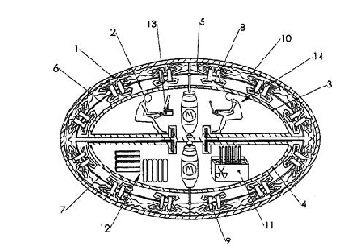
A patent for an alleged anti-gravity drive
In 2005, an article by Philip Ball in Nature about US Patent US 6,960,975 attracted attention. The patent describes a spacecraft in which a superconducting shield and electromagnetic fields are supposed to create an anomaly in spacetime curvature.
Contemporary reports quoted physicist Robert Park of the American Physical Society criticising such an anti-gravity machine as amounting to a perpetual-motion device. That was Park’s quoted argument, not a physical conclusion invented by me. Park used the case as an example of how a patent office could be impressed by pseudoscientific-sounding claims.
What a patent proves — and what it does not
The case remains instructive because the existence of a patent is easily confused with proof that an invention works. Granting a patent is not an independent experimental confirmation of the claimed physical effect.
My earlier wording was deliberately polemical and partly sarcastic: the “proud owner” of the patent had supposedly invented unlimited energy as well, while failing only to provide the evidence. The target of this exaggeration was the fallacy “patented, therefore it works.”
A cleaner logical distinction is:
- A hypothetical manipulation of gravity would not, merely for that reason, necessarily be a perpetual-motion machine; it might require energy.
- The concrete patent nevertheless describes spectacular physical effects for which robust independent evidence would be required.
- The patent grant itself does not provide that evidence.
The general reasoning error
Complex terminology, mathematical-sounding language and an official patent number can lend authority to a claim. Critical thinking asks a different question: What reproducible evidence exists for the claimed effect?
Patent: US 6,960,975, Space vehicle propelled by the pressure of inflationary vacuum state, granted 1 November 2005.