Almost everyone encounters stories about the mystical properties of pyramids at some point. The Great Pyramid of Giza in particular is associated with extraordinary geometric, astronomical and geographical claims. For a civilisation without a magnetic compass, its alignment to north is remarkably accurate. This demonstrates impressive Egyptian knowledge and surveying skill.
One numerical relationship that especially impresses mystics concerns the ratio of height and base dimensions and its approximation to expressions involving pi. For many this is treated as proof that the builders deliberately encoded the number π.
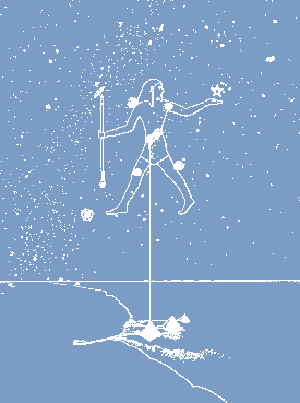
Modern pyramid mysticism goes further. The positions of Egyptian pyramids are said to mirror the constellation Orion — sometimes not as it appears today, but as it supposedly appeared around 10,500 BCE. Why should Egyptians thousands of years later — the Great Pyramid was built roughly in the third millennium BCE — have selected precisely that ancient configuration?
With enough possible buildings, mountains, cities, stars, epochs, measurement conventions and tolerances, computers and human pattern recognition can discover remarkable correspondences. The search space is enormous. One particularly weak claim is that the Nile, which was not designed by the pyramid builders, mirrors the Milky Way.
Within esoteric interpretations even air shafts acquire hidden astronomical functions. A shaft is said to point toward an important star of ancient Egypt. But common sense asks: for what purpose? The internet and esoteric literature are full of curious correlations that lead mainly to further mystical speculation.
A detailed critical discussion of numerical mysticism and π in pyramid construction was provided by Ralph Greenberg in Pi and the Great Pyramid.
Gero von Randow’s book Mein paranormales Fahrrad contains a related chapter, “Was ist Radosophie?”, by Cornelis de Jager. By analogy with pyramid mysticism, de Jager constructs pseudoscientific “proofs” of mysterious relationships around his paranormal bicycle. The satire demonstrates an important point: with enough freedom to choose measurements and transformations, meaningful-looking numerical coincidences can be manufactured almost anywhere.