Alternative medicine is one of those frequently used expressions that lack an exact definition. In the broadest sense it is a collection of concepts and methods with one main feature in common: they deviate from what is often called conventional medicine.
Alternative medicine therefore does not define a single coherent medical school. The label covers traditional methods that may still resemble conventional medicine, but also esoteric procedures that not only have little in common with science-based medicine but may reject scientific methodology altogether. Some of them are closer to religious or spiritual systems of thought than to empirical investigation.
The term complementary medicine is sometimes used as a synonym. In one sense it is the more revealing expression: everything outside conventional medicine is placed into a residual category. Yet the word “alternative” is particularly misleading when it suggests that a method is a genuine alternative to an established treatment. An alternative means that one has a choice between two possibilities, and that wording can create an impression of equivalence that has not been demonstrated.
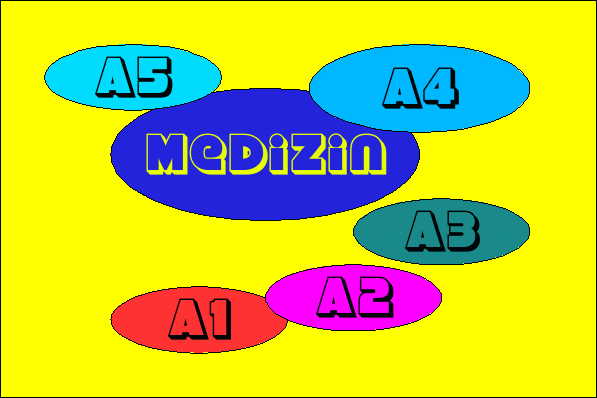
The diagram illustrates the problem. Every healing method outside the dark-blue oval labelled “medicine” falls into the complementary set. A hypothetical method A4 may overlap with medicine and share some features with it, while A1 may lie far away from scientific knowledge.
This explains why the broad category also contains many para-scientific or pseudoscientific methods: procedures for which scientific evidence of efficacy has not been produced, cannot be produced under the claimed assumptions, or is rejected in principle.
Conversely, once a method has demonstrated its efficacy by reliable scientific testing, it becomes part of medicine. It no longer needs a special protective label. Among the best-known areas commonly placed under “alternative medicine” are homeopathy and acupuncture.
The central question is therefore not whether a treatment is “alternative”, “natural” or “traditional”, but whether its benefits and risks are supported by reproducible evidence.