Distinguishing the terms
It is essential to distinguish carefully between the terms “biorhythm” and “biological rhythms”. Although they are often presented as if they belonged together, the popular biorhythm doctrine and biological rhythms — also called cycles — are different things. The activity of the sinus node in the human heart, for example, is a biological cycle.
Our lives, and those of other organisms and plants, are shaped by cyclical processes. The rotation of the Earth and its orbit around the Sun produce day and night and the seasons. Bodily functions have adapted to such recurring temporal patterns.
Origins
As early as 1814, the French pharmacist Julien Joseph Virey (1775–1846) investigated the dependence of pulse rate, blood pressure and body temperature on the time of day. He is associated with the expression “internal clock”. Such work contributed to what later became chronobiology.
Many experiments have shown that humans can retain biological rhythms even in isolation without ordinary external indications of time such as clocks, daylight or routine sounds. Under some experimental conditions the free-running daily period shifts away from exactly 24 hours.
The doctrine commonly called biorhythm theory is not part of chronobiology. It is not based on the same kind of scientific evidence and is rejected by mainstream science.
The original idea is generally associated with the ear, nose and throat physician Wilhelm Fliess (1858–1928), a friend of Sigmund Freud who was also involved in the early history of psychoanalysis. Fliess believed he had found recurring cycles in the case histories of his patients. He postulated a 23-day cycle for men and a 28-day cycle for women and believed these periods could be used to make statements about the course of health and even death. These ideas became a basis for later biorhythm systems; the theory was further developed by others, including the Viennese psychologist Hermann Swoboda.
Basic doctrine
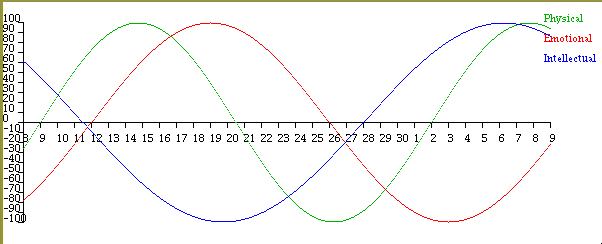
In its simplest popular form, biorhythm theory assumes three periodic processes that supposedly define physical, emotional and intellectual well-being:
- Physical rhythm (23 days): endurance, vitality and strength.
- Emotional rhythm (28 days): perception, mood and creativity.
- Intellectual rhythm (33 days): thinking, learning and logical comprehension.
The formulas are correspondingly simple. With age in days denoted by AT, the three values are often represented as sine curves with periods of 23, 28 and 33 days. At birth all curves begin at zero.
Criticism
- Unchanging periods. The curves are said to start at birth regardless of whether a child is born earlier or later than the calculated due date, vaginally or by Caesarean section. Even a premature infant is supposed to start these exact cycles at birth. The cycles then continue undisturbed regardless of lifestyle, exercise, sleep, jet lag or other influences. By contrast, measurable biological cycles vary and can be shaped or interrupted by external factors.
- No measurable underlying quantities. The alleged biorhythm curves are not detected as electrical, chemical, biochemical, hydraulic or otherwise measurable physiological processes. The theory produces calculated curves first and then interprets human experience through them.
The similarity of vocabulary is therefore misleading: real biological rhythms are empirical phenomena; the classic 23/28/33-day biorhythm doctrine is a numerically neat but unsupported interpretive scheme.