Two bank robbers and some lemon juice
On January 6, 1995, McArthur Wheeler and Clifton Earl Johnson robbed two banks in the Pittsburgh area. Rather than wearing conventional disguises, they had rubbed lemon juice on their faces. According to the story, they believed this would make them invisible to security cameras: after all, lemon juice can be used as invisible ink.
Wheeler reportedly even tested the idea with a Polaroid camera. His face did not appear in one photograph, and he apparently took this as confirmation of his theory. He failed to consider adequately that the photograph might have gone wrong for entirely different reasons.
Johnson was arrested a few days after the robberies. Wheeler was not apprehended until April, after surveillance footage was broadcast on television. The case prompted psychologist David Dunning to ask: Could lacking a skill also prevent us from recognising that we lack it?
Together with Justin Kruger, Dunning investigated this question. In 1999 they published Unskilled and Unaware of It, the paper that would become associated with the Dunning–Kruger effect.
A brief note on reading research critically: in their opening anecdote, Kruger and Dunning mention Wheeler but not Johnson. They also write that Wheeler was arrested “later that night.” Because the robberies are described immediately beforehand, a reader could easily understand this as the night of the crimes. In fact, more than three months elapsed between the robberies in January and Wheeler’s arrest in April. The detail about an arrest shortly after the television broadcast refers to news footage shown in April. This misleading chronology does not invalidate the experiments, but it illustrates why even the background stories of scientific papers deserve checking.
What is the Dunning–Kruger effect?
The term describes a pattern in which people with limited ability in a particular field often substantially overestimate their own performance. In Kruger and Dunning’s original explanation, such people may lack precisely the skills that would allow them to detect their own mistakes reliably.
If you do not know what makes a good solution, you may also be unable to judge what is wrong with your own solution.
This involves metacognition: our capacity to evaluate our own thinking, knowledge, and skills. Performing a task correctly and judging whether we performed it correctly are related, but distinct, abilities.
The idea is not a judgment about a person’s worth or intelligence. Nor does it imply that every beginner is overconfident. The researchers were studying a statistical pattern across groups of participants.
Kruger and Dunning’s four studies
The researchers conducted four studies with students at Cornell University. Participants completed tasks and estimated how well they had performed relative to others.
Humour
In the first study, participants rated jokes. Their judgments were compared with the ratings of professional comedians. Those whose judgments agreed less with this benchmark tended to overestimate their own ability to assess humour.
Logical reasoning
The second study tested logical reasoning. Again, the lowest-performing participants substantially overestimated their standing within the group.
Grammar
In the third study, participants completed grammar questions. The researchers also examined whether they could judge the quality of other people’s answers and use that information to reassess their own performance. The discrepancy between performance and self-assessment was again particularly pronounced among low scorers.
Training and self-awareness
The fourth study returned to logical reasoning. After taking a test, a randomly selected group received a short training session, while a control group completed a different activity. Participants then revisited the questions they had already answered and reassessed their original performance. Low-performing participants who had received training became much better at distinguishing their own correct answers from incorrect ones and at evaluating their earlier performance more realistically. The key finding concerned a better assessment of earlier answers, not improved scores on a new post-training test.
The 12th and 62nd percentiles
The original paper gives a striking result: participants in the bottom quarter of the performance distribution scored, on average, at the 12th percentile, yet estimated their relative standing at about the 62nd percentile.
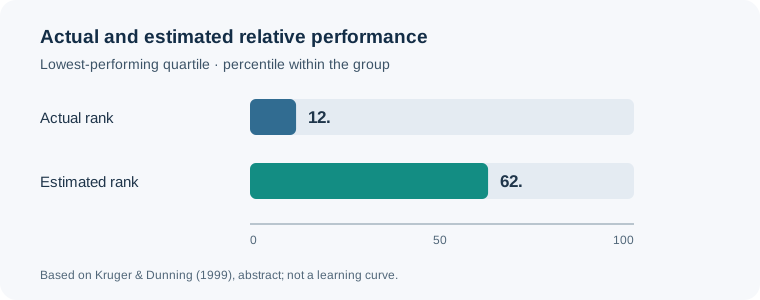
Being at the 12th percentile means performing better than roughly 12 per cent of the comparison group. A self-estimate at the 62nd percentile means believing oneself to be better than about 62 per cent. On average, these participants thought they were slightly above average, even though they belonged to the lowest-performing quarter.
High performers were not always perfectly accurate either: they sometimes underestimated their relative standing. These results establish a discrepancy between actual performance and self-assessment; identifying what causes the discrepancy is a separate scientific question.
The famous “Mount Stupid” curve is not an original figure
You may have seen the curve that rises steeply to “Mount Stupid,” plunges into the “Valley of Despair,” and then climbs gradually. Its horizontal axis represents knowledge or experience and its vertical axis confidence.
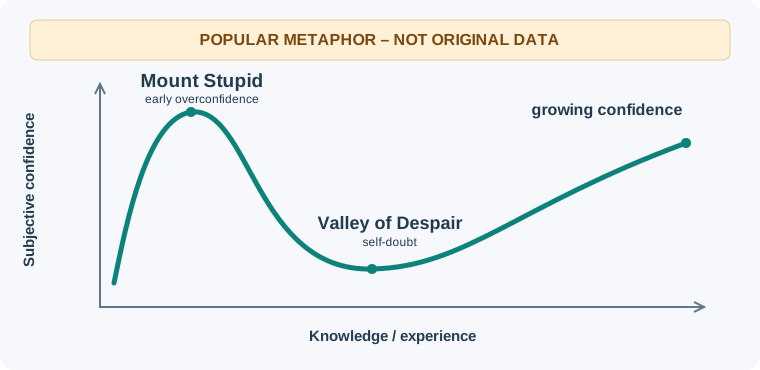
However memorable this graph may be, it is not from the original study. Kruger and Dunning did not track how one person’s confidence changed over years of learning. They compared the performance and self-assessments of different people; for example, Figure 1 on page 1124 of the original paper displays findings for four performance quartiles in the humour study. A cross-sectional comparison cannot simply be converted into a universal timeline of learning.
The popular curve may illustrate someone’s personal learning experience, but it is not an experimentally demonstrated history of our confidence. The fact that an unsupported diagram became so widely associated with this topic is itself a reason to think critically.
An example from teaching Python
Someone learning Python can soon start using variables, loops, and functions. These are genuine achievements. Programming might suddenly seem quite easy. Only later do they encounter recursion, generators, concurrency, software architecture, testing, and many other subjects.
At that point, someone’s subjective sense of competence may temporarily decrease even as their actual skills improve. They now have a clearer view of how extensive the field is. That is a possible learning experience, not evidence that everyone passes through the same rise-and-fall curve.
Politics and the illusion of understanding
Political problems can appear surprisingly simple as long as we focus on just one cause or one solution. Cut taxes, abolish an agency, introduce a particular technology: such proposals may be useful parts of a solution. But their consequences depend on interactions, assumptions, and competing objectives.
A related concept is the illusion of explanatory depth. We often think we understand something well until we are asked to explain its mechanisms step by step.
Fernbach and colleagues reported in 2013 that asking participants for such explanations sometimes moderated their political positions. A later preregistered replication by Crawford and Ruscio (2021) likewise found that participants recognised gaps in their understanding, but did not find reliable political moderation. That distinction matters: recognising what we do not understand does not necessarily change our opinions.
Having strong political views is therefore evidence neither of expertise nor of the Dunning–Kruger effect. We should examine arguments and evidence rather than dismiss political opponents with psychological labels.
Conspiracy theories and social media
Online, we can consume enormous quantities of articles and videos in just a few hours. But a large quantity of information is not automatically sound expertise. A crucial question is whether we can assess the quality and reliability of our sources.
On social media, confident statements may sound more authoritative than carefully qualified explanations. The confirmation bias plays a role as well: we tend to notice or accept information that fits our existing beliefs.
Yet it would be wrong to explain belief in conspiracy theories or political polarisation solely by invoking the Dunning–Kruger effect. Both have multiple individual and social causes. A claim must be judged by its evidence, not by a presumed psychological deficiency in the person making it.
Is the Dunning–Kruger effect scientifically controversial?
Yes. Researchers debate both the magnitude of the observed pattern and its explanation. One concern is the statistical structure of the tests. Someone at the bottom of a bounded performance scale has little room to underestimate their performance, but ample room to overestimate it. For the highest performers, the reverse is true.
Another issue is regression toward the mean: when two measures are not perfectly correlated, exceptionally high or low values of one often correspond to less extreme values of the other. Thus part of the familiar pattern might arise from statistical properties without requiring a special inability to judge oneself.
Using data on self-rated intelligence, Gignac and Zajenkowski argued in 2020 that much of the pattern could be a statistical artefact. In 2023, Dunkel, Nedelec, and van der Linden re-examined intelligence data and reported a small but statistically significant effect. Its size and the best methods for detecting it remain subjects of debate.
It is important to distinguish a person’s self-assessment of a specific skill, such as grammar, from their assessment of general intelligence. Results from one domain should not automatically be generalised to every other domain.
None of this criticism proves that people always assess themselves correctly. It shows why we must distinguish the observed pattern from the psychological mechanism proposed to explain it. That distinction is fundamental to good science.
Why are we so eager to spot the effect in others?
The Dunning–Kruger effect is often invoked against political opponents, self-appointed experts, or people with unusual beliefs. It is easy to forget that we ourselves are not immune to overestimating our knowledge.
When I take an opinion for granted, how do I know I have understood the key relationships? What information might I have missed? Would I notice a flaw in my own reasoning?
This does not mean that all viewpoints have equal merit. It means I should apply the same standards to my own assertions as to those of others. Four questions can help:
- What do I actually know? Which statements can I substantiate?
- How do I know it? How reliable are my sources?
- Can I explain it? Do I understand the mechanisms beyond a few slogans?
- What would change my mind? What evidence would make me reconsider?
Conclusion: knowledge and intellectual humility
The Dunning–Kruger effect is interesting not because it gives us a convenient label for supposedly incompetent people, but because it raises a question about how accurately we perceive the limits of our own knowledge.
The original experiments document striking gaps between performance and self-assessment. Subsequent criticism shows why we should not jump to a single explanation for those gaps. Even the popular picture of the effect demonstrates how easily a memorable narrative can eclipse actual research findings.
Recognising the limits of your own knowledge is itself a form of knowledge.
Perhaps critical thinking begins with a modest sentence: “I don’t know.” Not as an admission of weakness, but as a willingness to be corrected by stronger arguments and new evidence.
Scientific references
- Kruger, J., & Dunning, D. (1999). Unskilled and Unaware of It: How Difficulties in Recognizing One’s Own Incompetence Lead to Inflated Self-Assessments. Journal of Personality and Social Psychology, 77(6), 1121–1134. DOI · Original paper (PDF)
- Morris, E. (2010). The Anosognosic's Dilemma (Part 1). The New York Times. Historical background
- Gignac, G. E., & Zajenkowski, M. (2020). The Dunning-Kruger Effect Is (Mostly) a Statistical Artefact: Valid Approaches to Testing the Hypothesis with Individual Differences Data. Intelligence, 80, 101449. DOI
- Dunkel, C. S., Nedelec, J., & van der Linden, D. (2023). Reevaluating the Dunning-Kruger Effect: A Response to and Replication of Gignac and Zajenkowski (2020). Intelligence, 96, 101717. DOI
- Fernbach, P. M., et al. (2013). Political Extremism Is Supported by an Illusion of Understanding. Psychological Science, 24(6), 939–946. DOI
- Crawford, J. T., & Ruscio, J. (2021). Asking People to Explain Complex Policies Does Not Increase Political Moderation: Three Preregistered Failures to Closely Replicate Fernbach, Rogers, Fox, and Sloman’s (2013) Findings. Psychological Science, 32(4), 611–621. DOI
Further reading on this site: Occam’s Razor and the other articles in Critical Thinking.