Steps and Stones Music between landscape, history and memory
From the Trois Châteaux in Alsace through the rock formations of Valais to Belle Époque Paris: six pieces forming a musical and cinematic journey through time and space.
▶The four-movement symphony forms the centre of the album.
Steps and Stones brings together six compositions born from encounters with places, landscapes and historical images. The album begins with the four-movement symphony Le roi et ces trois chateaux, then travels to Valais with Sinvalaisphonie and to Paris between 1896 and 1900 with Paris Walks.
“Steps” refers not only to literal footsteps, but to movement itself: walking through landscapes, moving through history and passing between musical worlds. “Stones” are the castle walls, the rock pyramids of Valais, the Matterhorn and the stone architecture of Paris.
The album does not follow a continuous plot. Its unity arises from a shared artistic approach: visible places are not explained as documentary evidence, but transformed into sound, motion and memory. The four castle movements encounter medieval history and imagined power; Sinvalaisphonie regards geological forms, rock formations and mountains in Valais as enigmatic monuments; Paris Walks places early film footage in dialogue with a contemporary piano composition.
Stone preserves time. Music sets it in motion again.
The six pieces on Steps and Stones
No.
Title
Musical and visual world
1
The King and These Three Castles – The King
The three castles above Eguisheim appear as distant, solemn silhouettes.
2
The King and These Three Castles – Becoming the Pope
Movement, ascent and the historical trace of Bruno of Egisheim-Dagsburg, the future Pope Leo IX.
3
The King and These Three Castles – Enforcing Celibacy
Hohentwiel expands the visual world: not one of the three castles, but a powerful sign of history and resistance.
4
The King and These Three Castles – The King and the Pope
Hohentwiel in winter becomes the symphony’s monumental final image.
5
Sinvalaisphonie
Alpine rock formations, the Pyramides d’Euseigne and the Matterhorn between nature, monolith and transformation.
6
Paris Walks
Solo piano accompanies restored footage of Belle Époque Paris.
The centre of the album: this king and these three castles
The French word ces means “these”. The title therefore refers not to three arbitrary or merely invented castles, but to precisely those three castles that stood above the Alsatian landscape while the music was being written.
The king, by contrast, is not a particular historical figure. He belongs to the work’s imaginary world. He may represent past rule, the people who once lived in the castles, or history itself, present in the ruins yet simultaneously beyond reach.
The castles are real. The king comes into being in the music.
Not a historical retelling
The symphony does not attempt to recount the history of the three castles chronologically or assign one movement to each castle. Instead, the ruins become an inner landscape: images of power and transience, nearness and distance, memory and imagination.
The four parts trace a path from first sight, through motion and contemplation, to a monumental closing image. Brief motifs emerge, disappear and return from a changed perspective—just as the castles repeatedly appear between landscape and vegetation while one walks.
The four movements
I
The landscape opens
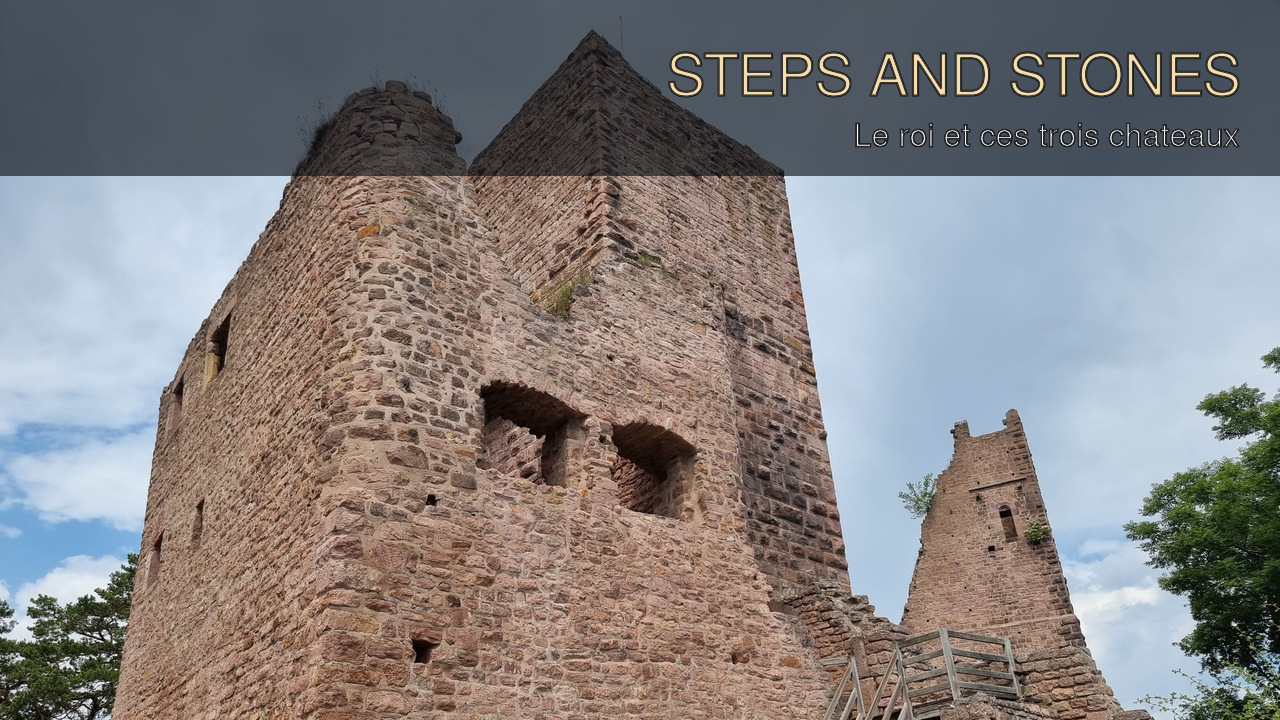
The first movement begins slowly and solemnly in F minor. Dark string colours and insistent repeated notes initially reveal the castles as a distant silhouette. The film shows Wahlenbourg, Dagsbourg and Weckmund above the Alsatian plain. Dagsbourg is associated with Bruno of Egisheim-Dagsburg, the future Pope Leo IX.
The longest movement unfolds mainly in a swaying 6/8 metre. The walls seem to dance with the rhythm. Later, a motif from the first movement returns in 4/4 and overlays the flowing motion. Two worlds seem to meet: Alsace and Rome, worldly origins and spiritual authority, landscape and history.
Hohentwiel takes centre stage in the third movement. It belongs neither to the king nor to the three Alsatian castles. Yet as a mighty fortress ruin on volcanic rock it expands the work’s idea: it becomes a symbol of vanished empires, defiant strength and a legacy that cannot be fully subordinated to any rule.
In the finale the ensemble grows from six to eight voices. The 9/8 metre creates a broad, sweeping motion and the dynamics rise to fff. Snow-covered walls and frosted towers transform Hohentwiel into an almost spectral monument to time—not one of the three castles, but an image of resilience and enduring grandeur.
The work’s tonal centre is F minor. It connects the four movements and gives the symphony its dark, historically conscious basic colour. Here, however, it is not merely melancholic: depending on rhythm, dynamics and instrumentation, it can sound mysterious, dramatic, archaic or monumental.
Movement
Tonal focus
Character
I
F minor → C major → F minor
Solemn, contrasting, finally receding
II
C major → F minor/A-flat major → C major
Moving, brighter, wandering
III
F minor with A-flat-major colouring
Inward, recollective, flowing
IV
F minor
Condensed, monumental, powerful
C major forms a brighter counterworld: the present, movement and the real landscape. A-flat major, the relative major of F minor, mediates between the two worlds and brings warmth to the fundamentally darker harmony.
The melodic writing: musical images instead of a long narrative
The melodic writing is strongly motivic. Short figures, repeated notes, small steps and suddenly opening wider intervals shape the work. Lines frequently circle a central pitch before a leap of a fourth, fifth or octave opens the musical space.
The result is not so much a series of long, songlike themes as a set of recurring musical images. Motifs are repeated, displaced and illuminated from another perspective. Especially in the final movement, melody becomes part of a larger architecture: it no longer belongs to one voice, but moves through the entire string texture.
Two films – the same music
The four-movement symphony has two different visual versions. The newer film returns to the actual locations and the historical ideas associated with them: the Trois Châteaux in Alsace, Pope Leo IX and finally Hohentwiel.
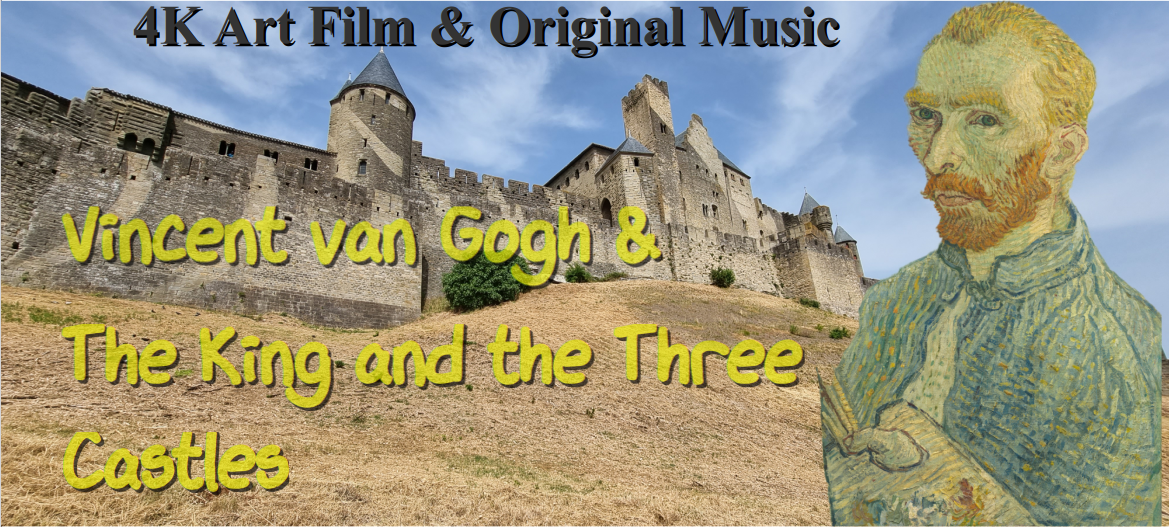
An earlier version uses twenty unchanged paintings by Vincent van Gogh. At first sight, Van Gogh’s pictorial world and the castle ruins near Eguisheim do not appear directly related. For me, however, the connection lies deeper: Van Gogh does not merely depict a landscape. Through colour, rhythm and motion, he transforms the visible world into an inward, emotionally intensified landscape.
Something similar happens in my music. It does not reconstruct the three castles historically, but transforms the sight of them into sound, memory and imagination. The strings’ recurring motifs meet Van Gogh’s rhythmic brushstrokes; harmonic concentrations encounter his luminous colour contrasts. Film and music therefore do not tell the same outward story. They share a way of experiencing landscape as a psychological space.
The dramaturgy, order and camera movement were newly created; Van Gogh’s paintings themselves were not altered.
After the four connected symphonic movements, the album opens in two new directions. Sinvalaisphonie enters an elemental Alpine world; Paris Walks enters the motion of a historical city. Both pieces leave the king and his castles behind, yet continue the album’s idea: landscape and architecture hold memory, while music creates a new present from it.
The title Sinvalaisphonie is a play on words that inserts Valais, the French name for the Swiss canton, into the sound and form of the word Symphonie. The ending -phonie is deliberate. Its 98 bars are scored for two flutes, clarinet, two trumpets and string orchestra. Increasingly bright registers grow from dark, low sound fields. Broad slow sections are interrupted by rapid dramatic surges, and the dynamic range extends from barely audible pp to massive ff.
The musical development recalls the expressive density of Schoenberg’s early sound world, Penderecki’s dark drama and, finally, the luminous spiritual calm associated with Arvo Pärt. These reference points do not describe stylistic imitation, but the piece’s journey: from weight and density towards light and stillness.
Chords, tonal centres and melodic writing
The harmony does not follow a continuous functional cadence. Instead, large tonal fields emerge in which A, G, D and E in particular act as changing centres. Open fifths, layered seconds and fourths, and chords with added notes make the sound fields seem both archaic and modern. Predominantly diatonic passages are brightened or darkened by F-sharp, C-sharp and occasional further chromatic notes. The harmonic impression therefore changes less through classical modulation than through shifting, compressing and breaking open blocks of sound.
At first, melody likewise does not develop as one long, closed theme. Short pitch sequences and small stepwise motions pass between flutes, clarinet, trumpets and strings. Repeated notes act like fixed points in the landscape; wider intervallic leaps suddenly open the space. As the piece unfolds, motifs rise from the low strings into ever higher registers. The melodic writing thus follows the same path as the film: from dark earthly weight, through rugged formations, to the luminous expanse of the peaks.
The film begins with sunrise over the Alps and a black pyramid, a deliberate homage to 2001: A Space Odyssey. This develops into the natural Pyramides d’Euseigne and other column-like rock formations. Near the end, the Matterhorn appears as a vast natural pyramid before the opening image returns on the horizon and closes the circle.
The album’s final piece is written for solo piano. Its 47 bars move in a calm 4/4 pulse of about 80 beats per minute. Changing dynamics, dialoguing figures between registers and triplet motion allow different footsteps, glances and layers of time to wander through the city.
Chords, tonality and melodic writing
The pitch material is almost entirely confined to the piano’s white keys. This creates an open space between C major and A minor, though its true centre of gravity often lies on E. Particularly characteristic is the alternation between E-minor sonorities over the bass note E and F-major fields over F. The immediate juxtaposition of E and F gives the music a gently modal, at times Phrygian tension without depriving it of warmth.
The chords rarely appear as simple triads. Added seconds, sevenths and sustained notes create floating four- and five-note sonorities. The bass motion E–F is later extended by D and C; the perspective changes while the diatonic basic material remains. The melody mostly moves stepwise, circling E, G, A and B and only occasionally opening into wider leaps. Triplets and brief figures alternate between high and low registers. The line therefore feels like a walk: it continues, pauses, looks back and sees the same place from another viewpoint.
The film shows restored footage made by the Lumière company between 1896 and 1900: Notre-Dame, Pont de l’Alma, Avenue des Champs-Élysées, Place de la Concorde, a passing fire brigade and the Tuileries Garden. The films were slowed to a more natural-looking speed and colourised with AI-assisted processes by hdconvert.com.
The music does not illustrate the images scene by scene. It creates a distance between then and now: we see real people and streets from the dawn of cinema, but hear a contemporary composition. The walk thus becomes both historical document and personal memory of a city that is constantly changing.