Four cinematic journeys — two with Van Gogh’s paintings unchanged, and two as clearly identified artistic extensions using generative AI.
Two different paths to Van Gogh
Vincent van Gogh (1853–1890) painted landscapes, people, rooms and objects with an intensity that reaches far beyond the merely visible. In his work, colour becomes movement, rhythm and inner tension.
My four Van Gogh films deliberately follow two different approaches. The first two focus exclusively on Van Gogh’s original paintings. The images themselves are not altered. What is new is only the selection, sequence, camera movement, attention to details and music.
The other two films ask a different question: What might lie beyond the frame? Here Van Gogh’s visual worlds are deliberately extended and reinterpreted with generative AI. At no point should these additional images be mistaken for works by Van Gogh. What is imagined remains recognisably imaginary.
A short life, an astonishing development
Vincent van Gogh was born in Zundert in the Netherlands in 1853. Before devoting himself fully to art, he worked in the art trade and also attempted to become a preacher. Only around 1880 did he commit himself decisively to life as an artist. He had roughly ten years of intensive work ahead of him, yet in that short period he created an extraordinarily extensive body of work.
His development can almost be followed geographically: the dark, earthy paintings of the Netherlands; his encounter with Impressionism, Neo-Impressionism and Japanese woodblock prints in Paris; the luminous south of France in Arles; the restless landscapes of Saint-Rémy; and finally the last months in Auvers-sur-Oise.
How Van Gogh painted
Van Gogh made the visible brushstroke an essential element of the painting. In many mature works the paint lies thickly on the surface — impasto — while lines begin to sway, circle or move rhythmically across fields, trees and skies. For him, colour was not merely a way to reproduce nature, but a means of intensifying expression.
Pure Van Gogh
The original paintings at the centre
In these two films nothing is added to, replaced in, or AI-extended within Van Gogh’s paintings. The new layer comes entirely from cinematic form and my music.
Sixty paintings from different phases of Van Gogh’s life and work. Slow camera movements lead from selected details to the complete painting, accompanied by more than two hours of my own music. The paintings themselves are neither altered nor extended.
Twenty original paintings become a concentrated journey in four musically and visually structured movements. The dramaturgy, sequence, camera movement and music are new; Van Gogh’s paintings remain untouched.
Here Van Gogh’s art is not only the work being viewed, but the starting point for an idea. AI generates possibilities; selection, direction, narrative and artistic decisions remain part of my own creative process.
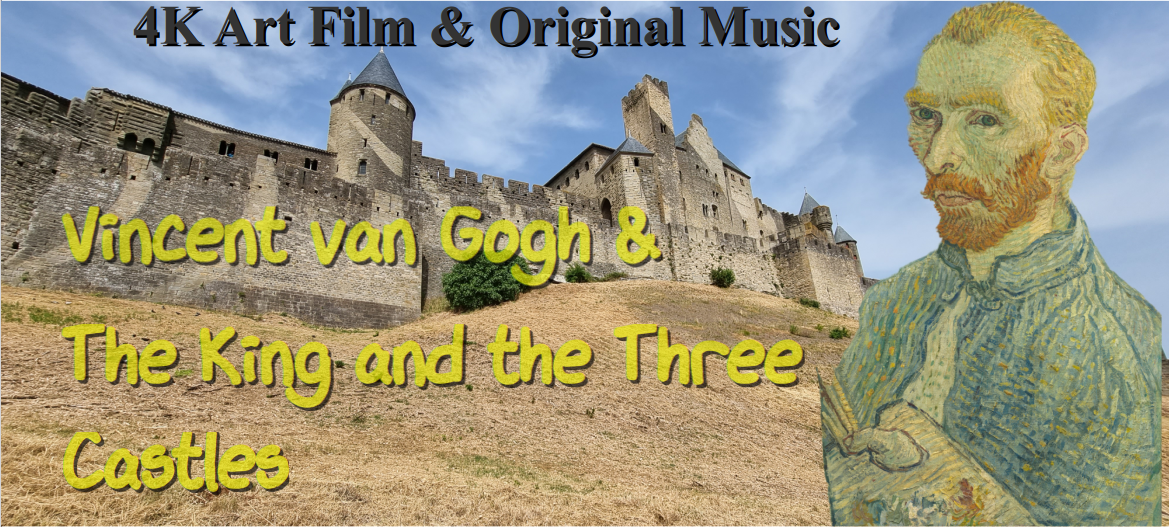
A French villa opens windows onto landscapes and interiors inspired by Van Gogh’s visual world. These spaces are not unknown Van Goghs and not reconstructions, but deliberately imagined scenes based on my own ideas and realised with generative AI.
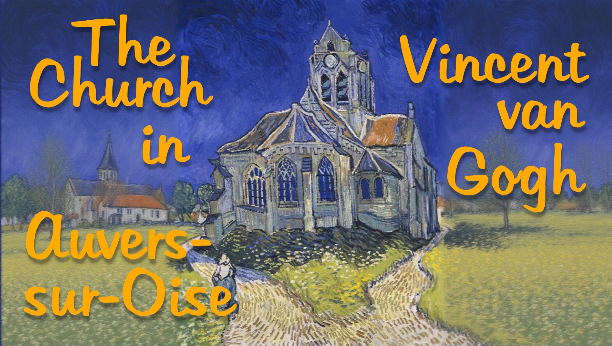
The Church at Auvers – What Lies Beyond the Painting?
Van Gogh’s The Church at Auvers initially remains untouched at the centre. Then the space opens beyond the edges of the painting: Where do the two paths lead? What might lie outside the frame? Later the church appears in freely imagined visual worlds recalling Monet, Picasso, Matisse and Caravaggio, before the film returns to the unchanged original.
Artists have always transformed reality: through exaggeration, abstraction, montage, collage, dream, shifts in perspective, variation and reinterpretation. Twentieth-century art also deliberately played with the loss of familiar contexts.
One example is René Clair’s avant-garde film Entr’acte from 1924. The visible world is accelerated, broken apart, recombined and pushed into the absurd. Its defamiliarization does not pretend to be documentary truth; its obvious unreality is precisely part of the art.
Art may defamiliarize reality. Fake news hides the fact that it falsifies reality.
This is exactly where I see the connection with my two experimental Van Gogh films. Nobody should believe that Van Gogh painted the additional images. The transformation is not deception; it is the subject of the experiment: what happens to our perception when a familiar image is deliberately continued beyond its historical boundaries?
The tool of generative AI is new. The artistic impulse to transform, quote and reinterpret reality is not.
Eel’usive Truth – when truth slips away
Both experimental Van Gogh films are accompanied by my jazz-fusion composition “Eel’usive Truth”. The title plays on elusive — difficult to grasp, slipping away — and the English word eel. Truth becomes something that repeatedly escapes a secure grip.
I play all the instrumental parts myself: bass, acoustic and electric piano, and tenor and soprano saxophone; the saxophones carry the leading voices through much of the piece. The drums are mine as well, played via keyboard. The music moves between groove, improvisation and unease — fitting images in which the boundary between historical reality and deliberate imagination begins to shift.
Entr’acte – defamiliarization long before AI
An earlier visual version of “Eel’usive Truth” is based on René Clair’s Entr’acte from 1924. The roughly twenty-minute film was created as an interlude for Francis Picabia’s Dada ballet Relâche; Erik Satie composed the music. From the outset, then, image, movement and music were brought together as a single artistic experiment.
An important point: I did not add any new visual content to the film with AI. The visible material comes essentially entirely from the original film. My interventions are cinematic and technical: I shortened it, changed the timing of individual passages, zoomed into images, reframed shots, reordered sequences and adapted the montage to my music. The result is a new version with a different rhythm, but the imagery remains recognisably faithful to the historical original.
Entr’acte itself deliberately removes the visible world from its familiar contexts. Marcel Duchamp and Man Ray play chess on a rooftop, a jet of water ends the game, a hearse is pulled by a camel, movement is accelerated, slowed down or reversed, images are superimposed, and an apparently ordinary situation suddenly turns absurd. The film does not follow documentary logic. Instead, it demonstrates how cinema itself can take reality apart and put it back together.
That is precisely why Entr’acte fits this Van Gogh project for me. Here too, the aim is not to pass off an invented world as historical truth. On the contrary, the transformation should remain visible. Van Gogh’s originals are clearly separated from my AI-assisted extensions, just as Clair’s film never claims that its absurd images are a representation of ordinary reality. The art arises precisely from the recognisable departure from it.
The connection goes further. Van Gogh transformed visible reality through colour, brushstroke and rhythm; Entr’acte did so through montage, tempo, superimposition and cinematic wit; generative AI now offers another way to think an image beyond its visible boundaries. The means change, but the artistic question remains remarkably similar: What happens to our perception when something familiar is suddenly continued in a way we do not expect?
This is also why “Eel’usive Truth” fits these images. In Entr’acte, familiar order slips away playfully and absurdly; in my Van Gogh films, the boundary between original, possible continuation and free interpretation is deliberately made visible. The decisive point remains the same: the transformation is disclosed — it is meant to provoke thought, not to deceive.
▶“Eel’usive Truth” with excerpts from René Clair’s Entr’acte — watch on YouTube.
Original music by Bernd Klein
These films are not neutral slide shows. The selection of images, camera movement, sequence and music combine in each case to form a coherent art film. More short Van Gogh videos and Shorts can be found directly on KleinTones.