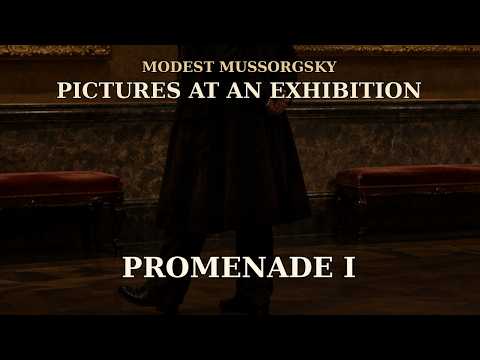
 01Promenade IWatch on YouTube →
The opening Promenade begins the walk and represents no individual Hartmann picture. My film introduces a figure resembling Mussorgsky in an imagined gallery filled with my newly created paintings.
KleinTones · 4K art film
Modest Mussorgsky’s journey through art, memory and musical imagination — reimagined as a cinematic gallery.
Modest Mussorgsky’s Pictures at an Exhibition has accompanied me for more than fifty years. This film is my attempt to turn that music back into pictures — not by reconstructing the past, but by imagining a new visual world around it.
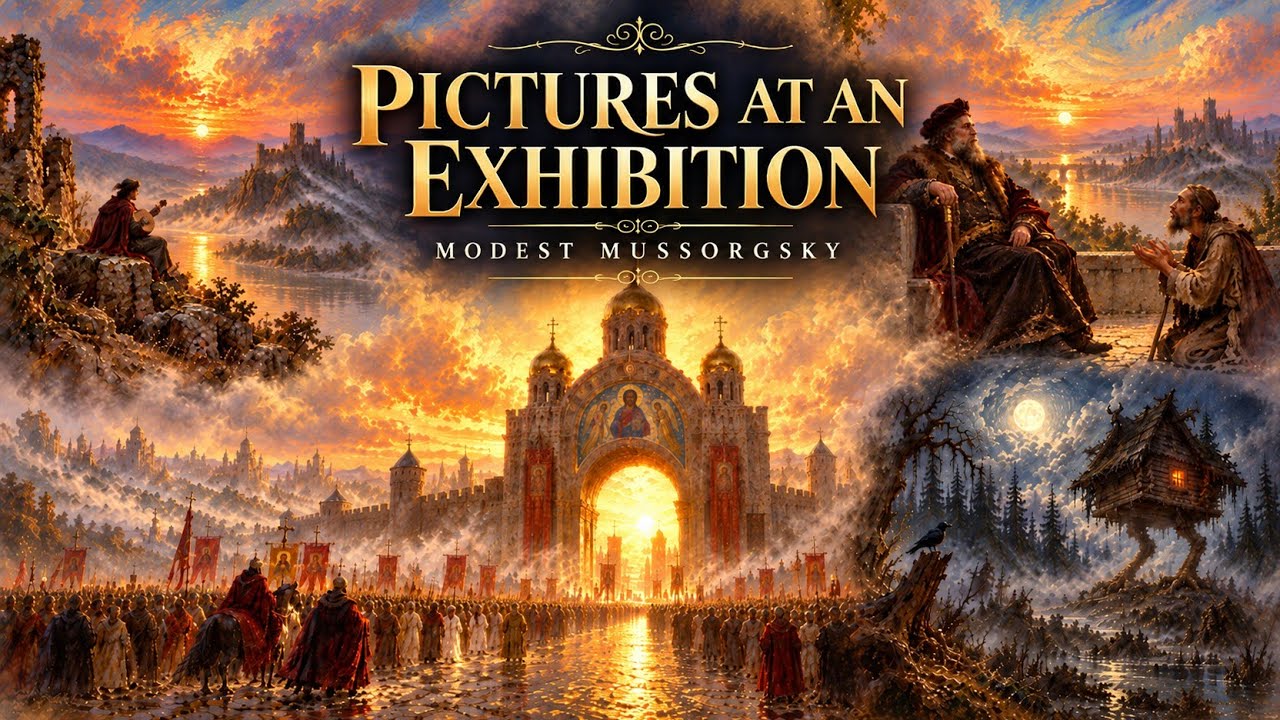
The piano cycle contains ten picture movements inspired by Viktor Hartmann’s work and five explicitly designated Promenades. The Promenades represent Mussorgsky walking through the gallery, his thoughts, memories and feelings changing between pictures. This video series therefore has fifteen parts, with Catacombae and Cum mortuis in lingua mortua combined in one film. The Promenade theme also returns within later picture movements.
My images are free reimaginings, rather than reproductions of Hartmann’s originals. Not all the source works survive; for lost works, the historical context relies on surviving descriptions. Drawings, watercolours, costume designs and architectural projects become a cinematic world of my own, inspired by Mussorgsky’s music and by Turner, Caspar David Friedrich and Van Gogh. The captions distinguish the historical starting point from my visual interpretation.
01Promenade IWatch on YouTube →The opening Promenade begins the walk and represents no individual Hartmann picture. My film introduces a figure resembling Mussorgsky in an imagined gallery filled with my newly created paintings.
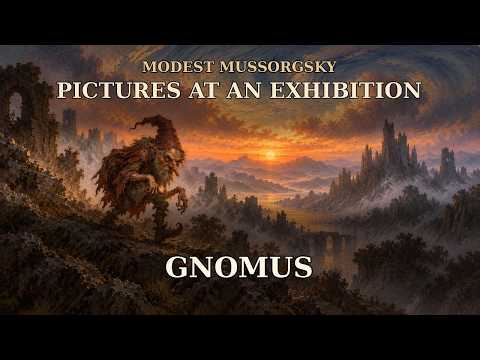 02GnomusWatch on YouTube →
The source for Gnomus is described as a nutcracker design shaped like a grotesque gnome. My film turns the idea into a fantastic figure in an expansive, unsettling landscape, guided by the music’s abrupt gestures.
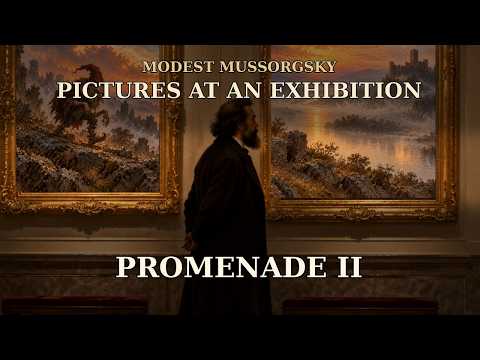 03Promenade IIWatch on YouTube →
The second Promenade resumes the walk after the first picture has changed its mood. My imagined gallery gives the musical transition a visible setting, with the composer contemplating newly reimagined paintings.
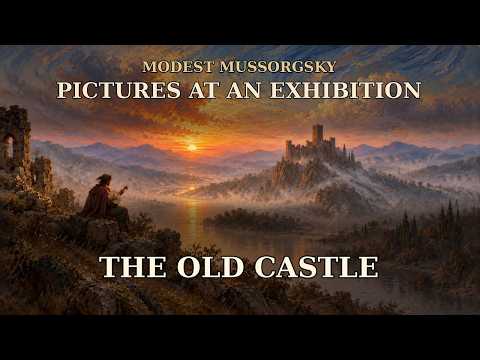 04Il vecchio castelloWatch on YouTube →
The historical source is described as an old Italian castle; the music suggests a troubadour’s song. My freely imagined castle landscape explores its melancholy through light, distance and slowly unfolding architecture.
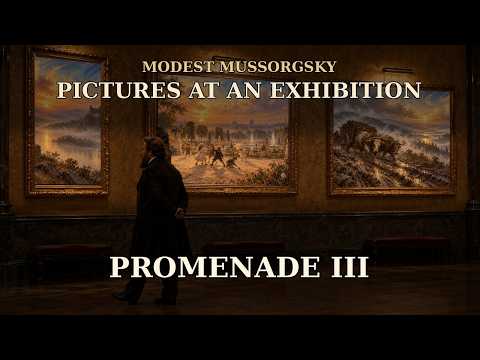 05Promenade IIIWatch on YouTube →
This brief Promenade leads toward the next picture. In my gallery, fleeting piano forms begin to suggest the transformation of visual perception into musical thought.
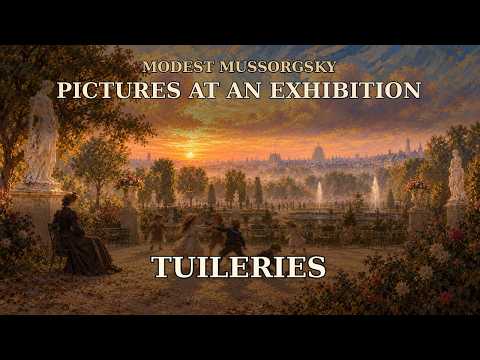 06TuileriesWatch on YouTube →
The source is described as children and their companions in the Paris gardens. My newly imagined garden scene responds to their games and quarrels through a visual world shaped by the music’s quick, restless gestures.
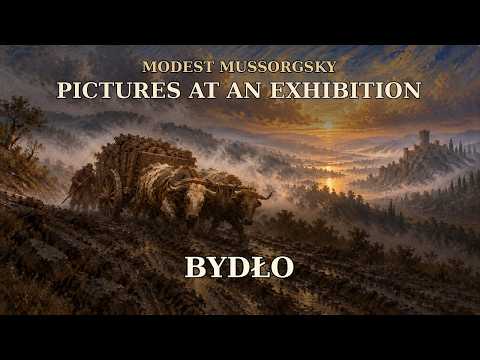 07BydłoWatch on YouTube →
Bydło is associated with a heavy Polish ox cart. My film places the motif in a broad landscape, translating the music’s weight, approach and recession into a sense of motion and distance.
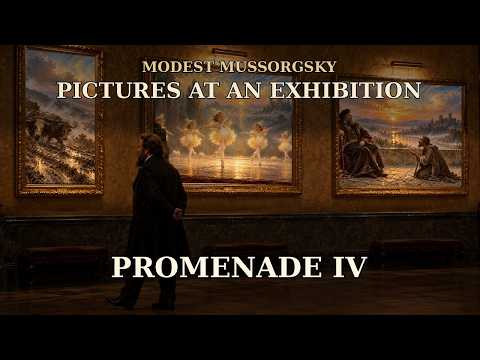 08Promenade IVWatch on YouTube →
The fourth Promenade connects the weight of Bydło with the lighter scenes ahead. Musical transformations become more sustained in my gallery, dissolving the boundary between the pictures and the composer’s imagination.
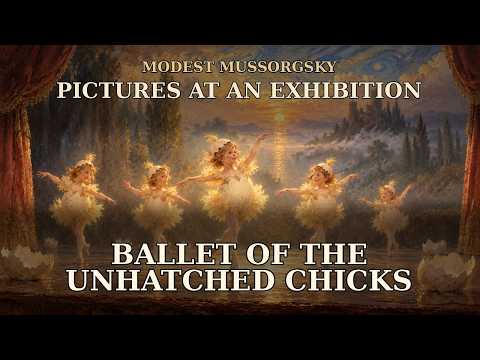 09Ballet of the Unhatched ChicksWatch on YouTube →
Hartmann’s surviving source is a ballet costume design with figures wearing eggshells. My film transforms the theatrical design into a fantastic scene whose chicks, movement and light respond to the music’s playful delicacy.
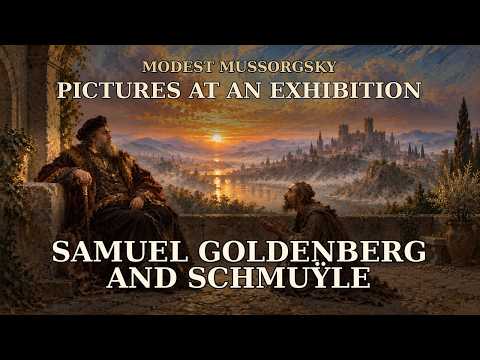 10Samuel Goldenberg and SchmuÿleWatch on YouTube →
Two portraits, traditionally associated with a wealthy and a poor Jewish man, form the historical starting point. My image turns their contrasting characters into an encounter, echoing the tension between commanding and insistent musical voices.
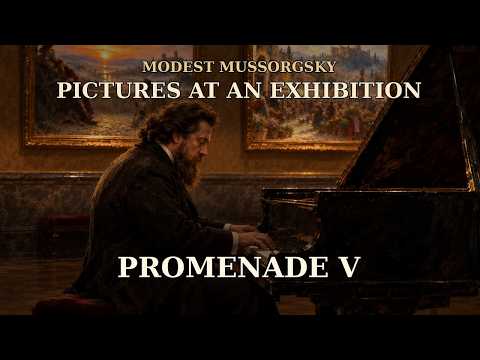 11Promenade VWatch on YouTube →
The fifth and final explicitly designated Promenade leads into the last part of the cycle. In my film Mussorgsky reaches a grand piano and sits without sheet music: looking at pictures becomes playing from memory and imagination.
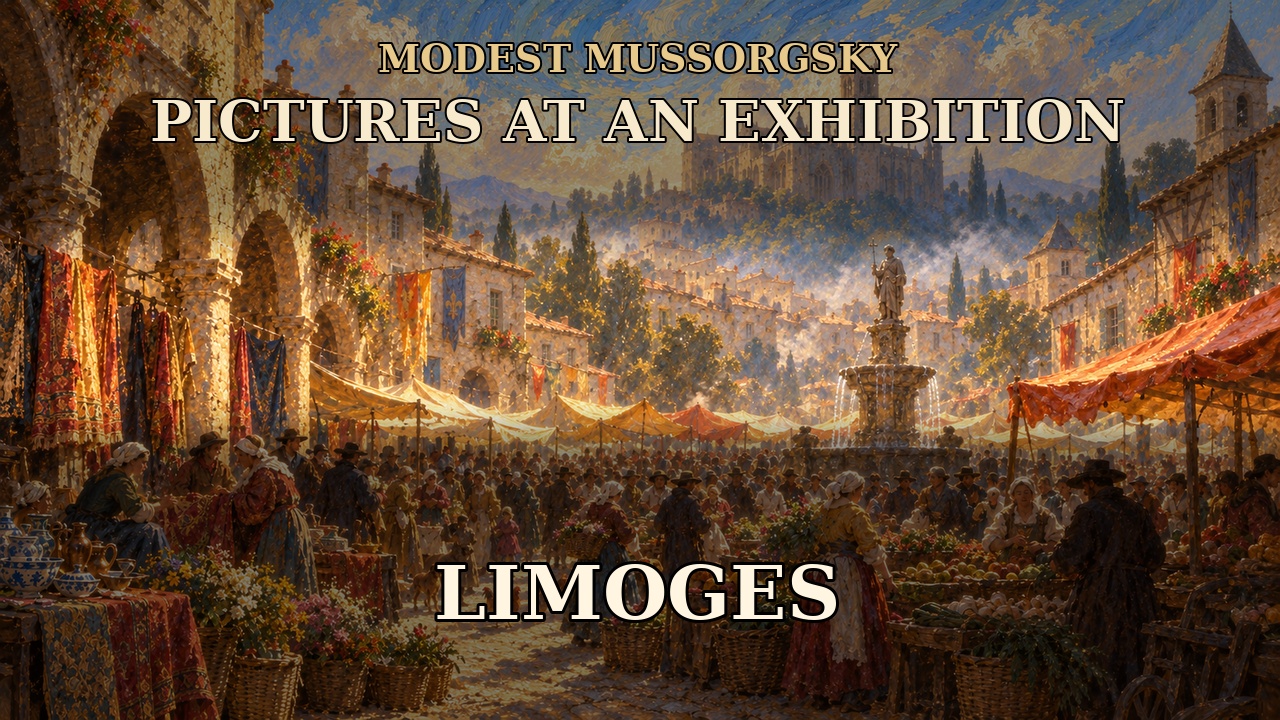 12Limoges — The MarketWatch on YouTube →
The historical starting point is a market scene in Limoges, rendered in music as busy voices and movement. My image expands it into a crowded, luminous square that responds to the movement’s restless energy.
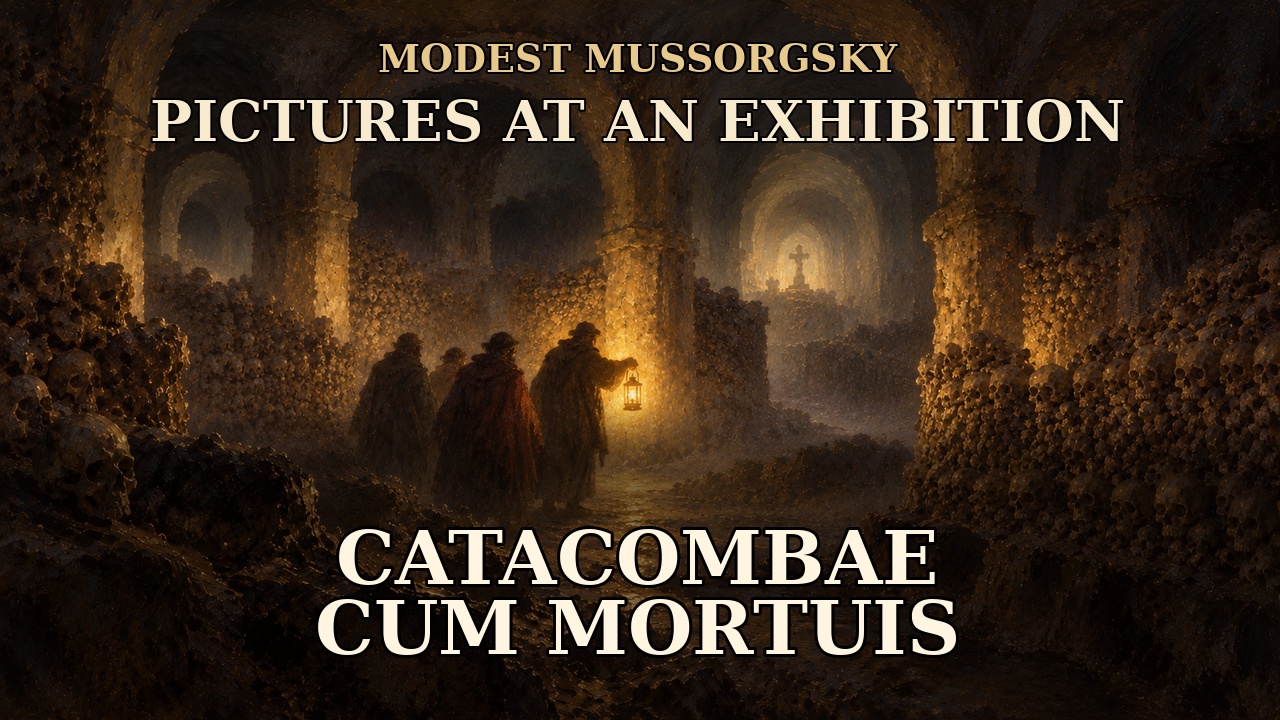 13Catacombae & Cum mortuisWatch on YouTube →
Hartmann’s surviving watercolour depicts a visit to the Paris catacombs. My interpretation opens this into an expansive, dark world of remembrance. In Cum mortuis, the transformed Promenade turns the walk into an inward encounter with the dead.
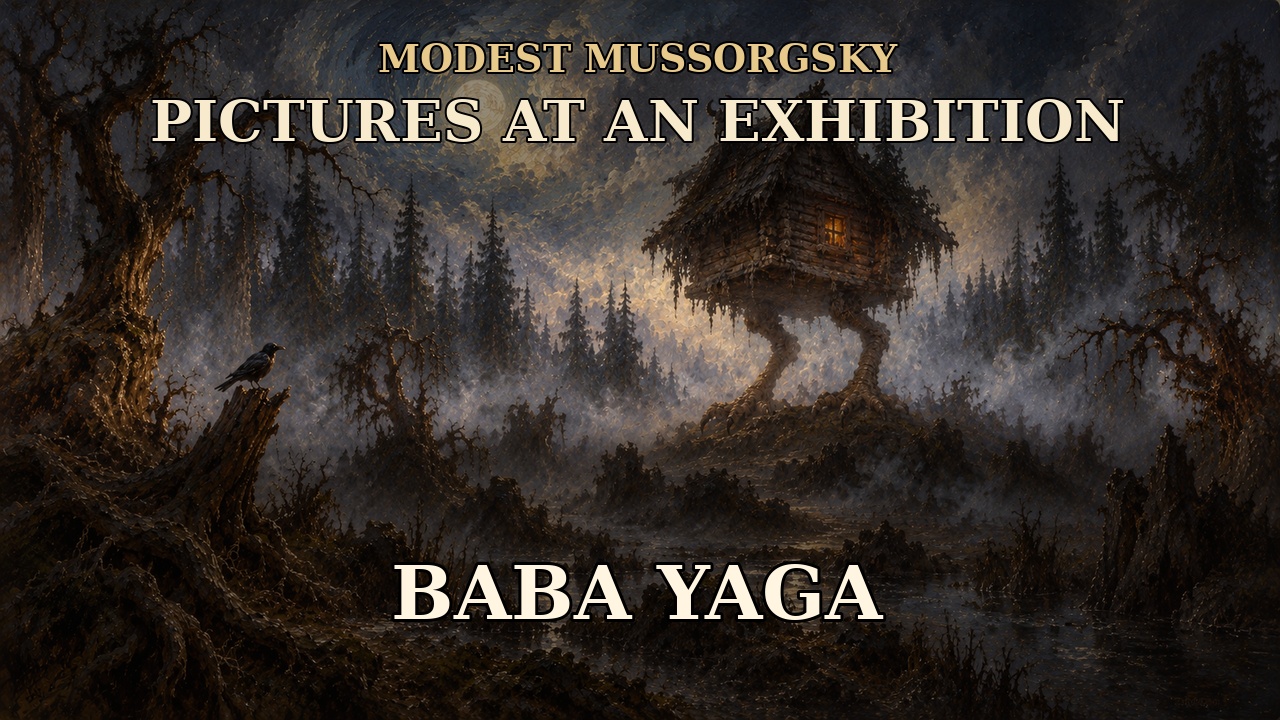 14Baba Yaga — The Hut on Fowl’s LegsWatch on YouTube →
Hartmann’s source was a clock design shaped like Baba Yaga’s hut on chicken legs. My film frees the hut from that object and places it in a wild, fantastic landscape, propelled toward the finale by fierce rhythms.
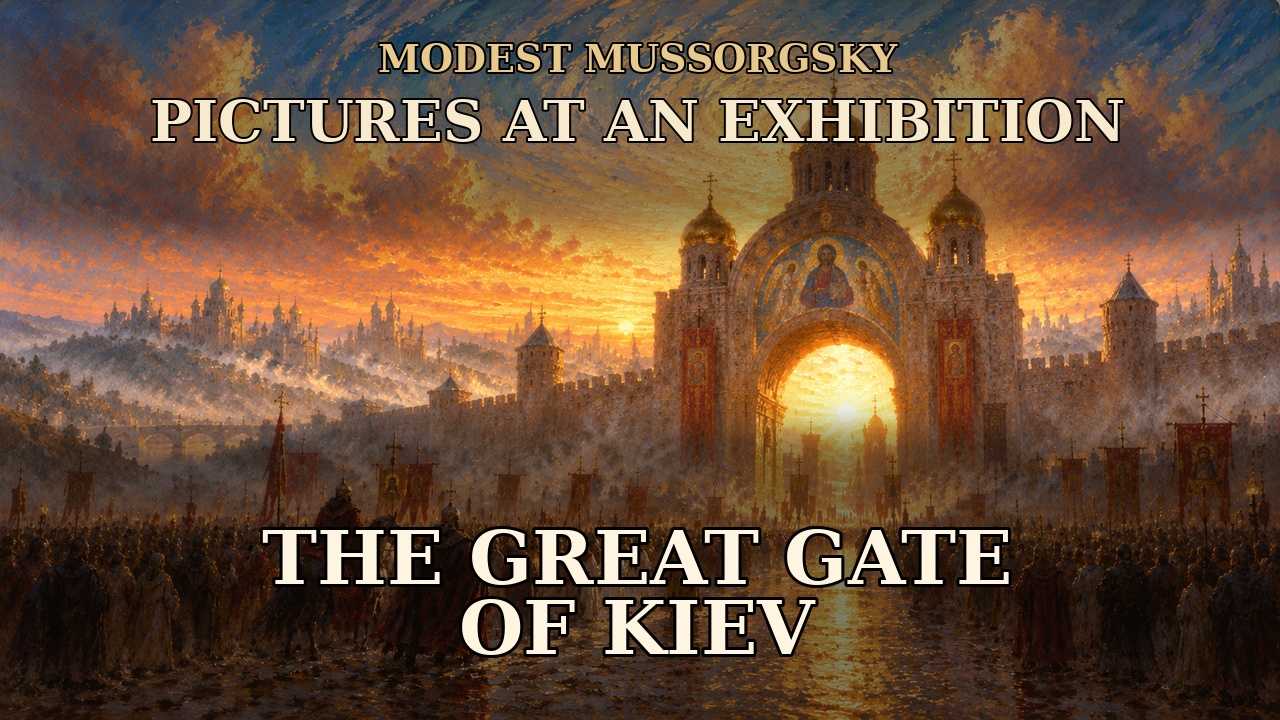 15The Great Gate of KievWatch on YouTube →
Hartmann designed a monumental gate for Kyiv, but it was never built. My film turns the architectural drawing into a luminous, inhabited vision, answering the finale’s majestic chords, bell sonorities and returning Promenade theme.
I first discovered Pictures at an Exhibition when I was about fifteen years old — not through Mussorgsky’s original piano score, but through the famous interpretation by Emerson, Lake & Palmer. Their recording fascinated me and, for a time, became one of my favourite albums.
Later I returned to Mussorgsky’s original piano composition and played parts of it myself, particularly some of the movements that meant the most to me. I never performed the complete cycle, but the music remained part of my musical memory.
Over the decades it moved somewhat into the background. Then, while creating my more recent films about painters such as Turner, Caspar David Friedrich, Van Gogh and Klimt, an old question suddenly returned:
What did the pictures behind Pictures at an Exhibition actually look like?
Mussorgsky wrote the suite after the death of his friend Viktor Hartmann, a Russian artist and architect who died suddenly in 1873 at the age of only thirty-nine.
A large memorial exhibition of Hartmann’s drawings, watercolours, architectural designs, stage sets and costume designs was subsequently held in Saint Petersburg. It was this exhibition that became the inspiration for Mussorgsky’s composition.
But there is a difficulty for anyone who wants to visualize the work today: most of the particular Hartmann works behind Mussorgsky’s music have disappeared. Only a small number survive.
The surviving images are historically fascinating. Yet, for me personally, they did not evoke the same overwhelming imaginative world that I hear in Mussorgsky’s music.
This is not intended as an art-historical judgement on Hartmann. It was simply the point at which I realised that I did not want to make a documentary reconstruction.
This music needed another visual world.
Their 1971 live adaptation translated selected material into progressive rock, with amplified instruments, vocals and new passages. It offered rock listeners another route into Mussorgsky. It could not influence the original composition, written almost a century earlier. For me, hearing ELP at about fifteen was the beginning of a lifelong connection with this music.
Mussorgsky and this suite were already established in classical music, including through Ravel’s 1922 orchestration. ELP broadened the audience; they did not create his reputation.
It strengthened their reputation. Their breakthrough at the 1970 Isle of Wight Festival, their debut album and the success of Tarkus preceded the release of the Pictures live album.
I therefore decided to reimagine the works rather than attempt to reproduce them historically.
I wanted something of Joseph Mallord William Turner: his extraordinary light, atmosphere and dissolution of solid forms. I wanted something of Caspar David Friedrich: his silence, distance, monumental scale and the feeling of a human being confronted with something larger than himself. And I wanted a subtle trace of Vincent van Gogh: movement, nervous energy and living texture.
But the goal was never to imitate one of these painters. Gradually, through the work on the individual scenes, another visual language began to emerge — one that never existed historically, but which, for me, belongs to Mussorgsky’s music.
I used generative AI extensively in creating the images, but not as a shortcut.
The pictures did not emerge from a single prompt. The visual world of the film developed over many days through trial and error: generating, judging, rejecting, changing and refining again and again.
Hundreds of images were generated. Most of them were never used. Composition, perspective, atmosphere, lighting, figures, architecture and small details were repeatedly altered until an image began to correspond to what I had imagined.
Sometimes an image was technically impressive but emotionally wrong. Sometimes the atmosphere was beautiful but the composition did not work. Sometimes a single small detail destroyed an otherwise convincing image. And sometimes, after many unsuccessful attempts, an image suddenly appeared that felt right.
For me, this is an important distinction. AI generated possibilities. But the creative process consisted in deciding what I wanted, recognising what was wrong, rejecting what did not work and continuing until the result fitted the artistic idea.
The Promenade movements are different from the other sections of the suite. They are not pictures. They represent Mussorgsky himself moving from one work to another through the exhibition.
This suggested another idea: Mussorgsky himself should enter my film — or, more precisely, a figure resembling him.
I created an imagined nineteenth-century gallery through which he walks, surrounded by the newly created pictures. The paintings used in the film had to appear convincingly inside the gallery frames.
This turned out to be one of the technically most difficult parts of the project. The perspective of the frames, the scale and angle of the pictures, the relationship between Mussorgsky and the paintings, the lighting and the shadows all had to work together before the gallery began to feel believable.
Yet even after the gallery worked visually, I was not completely satisfied. Showing Mussorgsky walking through an exhibition explained what was happening externally. But what about what might be happening inside the composer’s imagination?
I left the problem alone for several days. Then another idea emerged: perhaps the Promenades could gradually show the transformation from visual perception into musical thought.
This is, of course, not a claim about what Mussorgsky literally experienced. We cannot know the exact psychological moment in which a particular Hartmann image became music. It is a cinematic interpretation.
At first we remain in a relatively realistic gallery. Then, in later Promenades, something strange begins to happen. For a moment, a piano appears inside one of the pictures. Then it disappears. In another painting, piano keys or instrumental forms briefly intrude into the visual world. Reality returns. Later, the transformations last longer.
In Promenade III they are fleeting flashes of thought. By Promenade IV they have become more stable. The boundary between the physical gallery and musical imagination gradually begins to dissolve.
Finally, in Promenade V, Mussorgsky arrives at a real grand piano. He sits down. There is no sheet music. He begins to play from memory and imagination.
The pictures have become music.
For the soundtrack I deliberately returned to Mussorgsky’s original conception. Pictures at an Exhibition was written for solo piano, even though many listeners today also know the work through orchestral arrangements.
In principle, I could have played parts of the music myself. I had already played some of the movements when I was younger. But I had not played the work for many years, and preparing and recording the complete cycle at the level I wanted for the film would have required a great deal of practice and time.
Fortunately, I discovered the recording by Chiara Bertoglio.
For me, her playing is a wonderful interpretation of Mussorgsky’s work: precise, imaginative, expressive and full of musical character. I do not think I could have matched what she achieves in this recording, and her performance became the ideal musical foundation for the film.
I am particularly grateful that this excellent recording is available under a Creative Commons Attribution 3.0 licence.
Once the images had been created, another part of the work began.
Camera movement, zoom, transitions, timing and synchronization with the music all had to be developed. The intention was not simply to display a sequence of paintings while a recording played in the background.
I wanted image and music to breathe together — sometimes allowing the viewer to contemplate an entire composition, sometimes moving slowly toward a detail, sometimes letting the visual rhythm follow the musical tension.
AI was deeply involved in creating the visual material, and I have no reason to hide that. But saying that the film was simply “created by AI” would miss most of the process.
AI generated possibilities. I chose the artistic direction, rejected images, requested alternatives, changed compositions, controlled perspective and atmosphere, developed the Promenade narrative, planned the camera movements and synchronized the visual journey with the music.
For me, the more interesting question is therefore not simply whether AI was used. The more interesting questions are whether there was an idea, imagination, judgement, meaningful artistic decision-making and a personal vision.
This film is my response to music that has accompanied me since I was about fifteen years old.
It began with Mussorgsky. Along the way came Viktor Hartmann, Emerson, Lake & Palmer, Turner, Caspar David Friedrich, Van Gogh, decades of music, and my own more recent work with visual art and film.
More than fifty years after I first encountered this music, it has become something new in my imagination:
a gallery that never existed,
paintings that never existed,
and perhaps a glimpse into a creative moment that we can never actually witness —
the moment when pictures become music.
For solo piano. Ravel’s later orchestration is a separate interpretation.
Music
Modest Mussorgsky — Pictures at an Exhibition
Piano
Chiara Bertoglio
Recording source
IMSLP, file #251520
License of the recording
Creative Commons Attribution 3.0 (CC BY 3.0)
Visual concept, artistic direction & film
Bernd Klein
AI-assisted visual creation
Developed through an extensive iterative process of generation, selection, correction and refinement by Bernd Klein with OpenAI ChatGPT.
Visual language inspired by
Joseph Mallord William Turner
Caspar David Friedrich
Vincent van Gogh
The original composition by Mussorgsky is in the public domain.
Subtitles are available in English, German, French, Italian and Turkish.
LA Phil — Pictures at an Exhibition · Emerson, Lake & Palmer — Timeline