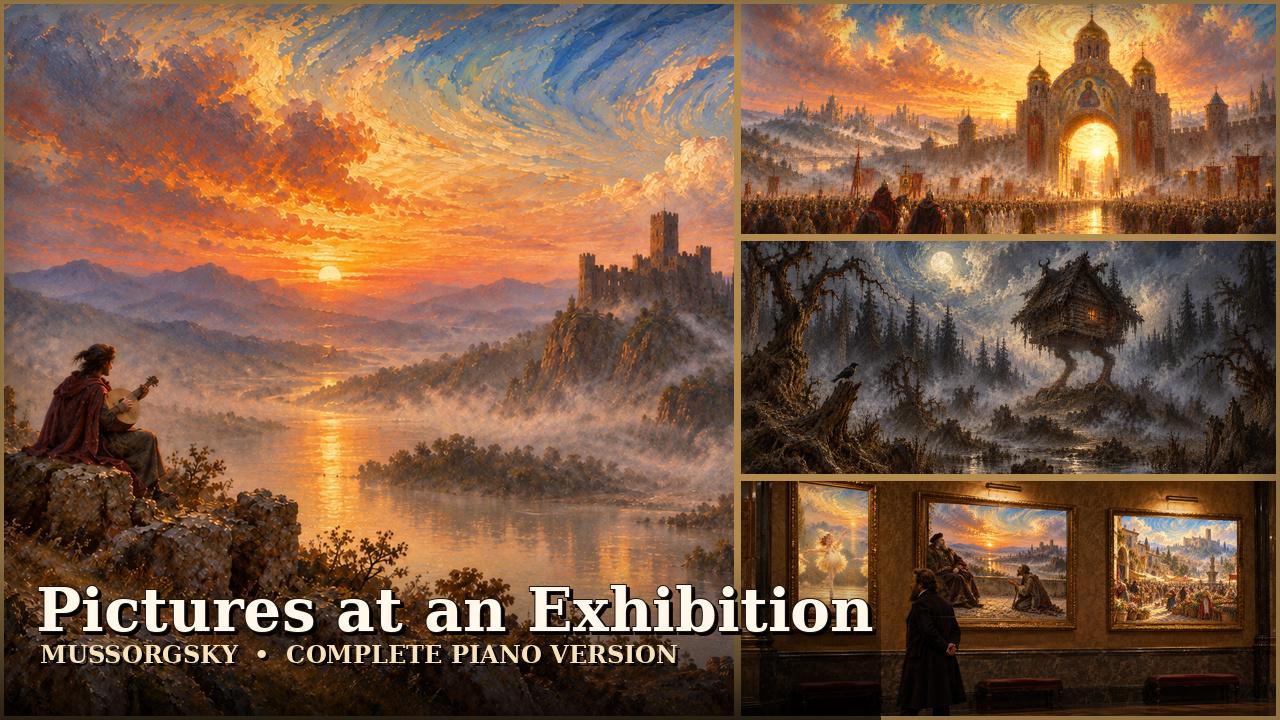
This text did not begin for me as an article about copyright. It really began with music, images and a project that has accompanied me for decades.
As a teenager I first encountered Modest Mussorgsky’s Pictures at an Exhibition through Emerson, Lake & Palmer. Later I became interested in Mussorgsky’s original piano version and played parts of it myself. In 2026 I finally realised an idea that had stayed with me for a long time: to turn the work back into pictures as a complete visual cycle.
For the soundtrack I did not use just any recording from the internet, but a specifically documented, freely licensed performance by the pianist Chiara Bertoglio. It is available on IMSLP under Creative Commons Attribution 3.0.
IMSLP work page
Direct MP3 file from which my videos were created
My Python production program cut the required passages from exactly this file. The starting point was therefore unusually clear: I knew not only which performance I had used, but also exactly which file every excerpt came from.
Then Content ID appeared
YouTube detected copyrighted music in my videos. At first, that did not particularly surprise me. Different pianists play the same composition. Pitches, harmonies, form and large parts of the temporal structure are necessarily similar. An automated system can therefore produce a false match.
The initial match itself was not what bothered me.
It became problematic when the automated match turned into a claim — and when it became clear that there was more than one.
| Claim | Recording assigned by Content ID | Match | Claimant | Type |
|---|---|---|---|---|
| 1 | Pictures at an Exhibition: XI. Promenade – Sa Chen | 0:06–1:26 | PIAS on behalf of Pentatone | Copyright – Audio |
| 2 | Pictures at an Exhibition: Promenade 4 – Steven Osborne | 0:07–0:59 | UMG on behalf of Decca (UMO) (Classics) | Copyright – Audio |
| 3 | Mussorgsky: Pictures at an Exhibition: II. The Old Castle – Alexis Weissenberg | 0:06–4:21 | WMG on behalf of WM France | Copyright – Audio |
| 4 | The Diner – Pictures At An Exhibition. Promenade – Gega New | 18:40–20:00 | SourceAudio Holdings LLC, Naxos Digital Services US, Inc. | Copyright – Audio |
| 5 | Pictures at an Exhibition: No.4 Bydlo – Mana Fukui | 11:07–13:55 | Kobalt Music Publishing, Wise Music Group, Warner Chappell | Copyright – Melody or lyrics |
Status of this overview: September 2026. Claim 5 should not be treated as equivalent to the four audio claims: “Melody or lyrics” concerns a different layer of rights from a claim to a specific sound recording.
One recording — several alleged identities
At that point the case became, for me, an exercise in critical thinking.
The decisive question is not: Can an algorithm be wrong once? Of course it can.
The more interesting question is:
How reliable is a specific identification when the same documented source material is assigned to different commercial recordings by different performers?
Different excerpts from my Chiara Bertoglio recording are associated with Sa Chen, Steven Osborne, Alexis Weissenberg and a recording from the The Diner/Gega New catalogue.
The Promenade is particularly striking. Content ID assigns material from my project both to a Sa Chen/Pentatone recording and to another commercial recording of a Promenade.
This does not mathematically imply that Content ID would necessarily identify Sa Chen and that other recording as identical to each other. Similarity is not transitive: from A being similar to B and A being similar to C, it does not automatically follow that B is similar to C.
But it does show something else that matters when evaluating the claim: the mere existence of a Content ID match clearly does not prove here that the specific master recording named in the claim was actually used in my video.
Not “it sounds different to me”, but a cross-check
After my first dispute against the Sa Chen claim was rejected, I did not want to rely on memory or subjective listening. I purchased the official Sa Chen/Pentatone recording and compared it with the audio extracted directly from my video.
I also used several controls:
- the original Chiara Bertoglio file from IMSLP,
- an independent copy of the same Chiara performance,
- the officially purchased Sa Chen/Pentatone recording,
- a recording by another pianist as a human control,
- two synthetic MuseScore renderings of the same score.
The analysis measured not only pitch structure, but also the timing of note attacks, tempo and rubato patterns, and dynamics. These are precisely the kinds of features that help distinguish the same composition from the same specific performance.
The result was clear: the excerpt extracted from my video matches Chiara Bertoglio very closely and differs distinctly from the Sa Chen/Pentatone recording examined.
I documented the complete technical examination, including methodology, numerical results, plots, file hashes and reproducibility, in a PDF:
Open the technical evidence report (PDF, German) →
The more important question: What would disprove my assumption?
This is exactly where the case becomes a matter of critical thinking.
I was convinced that the claims were wrong. But conviction is not evidence. The investigation therefore had to leave open the possibility that I myself was mistaken.
The useful question was not:
How can I prove that YouTube is wrong?
It was:
What observation would show that my own memory or documentation is wrong?
If the soundtrack extracted from my video had matched the performance-specific characteristics of the Sa Chen recording rather than Chiara Bertoglio, I would have had to revise my assumption.
That is exactly why the controls mattered. An analysis that compared only Chiara with my video might look overly favourable because both recordings contain the same notes. Other human and synthetic performances show what similarity arises merely from the composition — and what additional agreement points to the same performance.
When the same error affects several different videos
My project does not consist only of one complete film. Parts of the work were also published as separate videos. That creates another asymmetry that I find problematic.
A Content ID claim is not yet a copyright strike. YouTube itself explains that a strike can arise only when a valid copyright removal request is processed. A single video can receive only one copyright strike at a time even if it has multiple claims.
That limitation does not apply collectively to different videos. If the same misidentification affects several partial videos and several procedures escalate, separate strikes can result. Under YouTube’s current rules, three active copyright strikes within 90 days can lead to channel termination.
YouTube Help: Appeal a Content ID claim
YouTube Help: Copyright strikes
This creates a peculiar situation. Suppose I challenge the same, in my view incorrect, claim on two different videos. If both procedures were to escalate to valid takedowns, two strikes could result. With the next questionable claim, the issue would no longer be only whether I am factually right, but whether I can afford to keep defending that position.
I find it difficult to regard as balanced a procedure in which, after two possible erroneous decisions, contesting a third case could put my entire channel at risk.
This is not a claim that YouTube or a rights holder deliberately wants to intimidate users. I cannot judge intentions. I can only describe the effect that the structure of such a procedure can have on an individual user.
From one case to a more general question
For me, this case has therefore become much more than an annoyance involving a YouTube video.
It illustrates several basic principles of critical thinking very clearly:
- A claim is not evidence. Even a technically generated claim must be open to verification.
- Independent cross-checks are stronger than subjective certainty.
- Control examples matter. They show which similarities are trivial or system-driven.
- Transparency matters. Anyone making a specific claim should be able to identify as precisely as possible what that claim is based on.
- The cost of errors is part of a system. Even a correctable mistake becomes problematic when the burden of proof and risk falls almost entirely on the person affected.
On my website geistiges-eigentum.eu I have documented the case in greater detail from the perspective of copyright, Content ID and procedural asymmetry.
Read the detailed article on geistiges-eigentum.eu (German) →
The appeal against the Sa Chen claim has been submitted. At the time of writing, I do not yet know what will happen.
The central factual question, however, is remarkably simple:
Which recording is actually heard in my video?
According to the source chain, my production program and the technical cross-check, the answer is:
Chiara Bertoglio.
Status: 17 September 2026. This text describes an ongoing Content ID case and will be updated if there are significant new developments.