A quotation I came across on Facebook, attributed to Morgan Freeman — though the attribution is uncertain — made me stop and think:
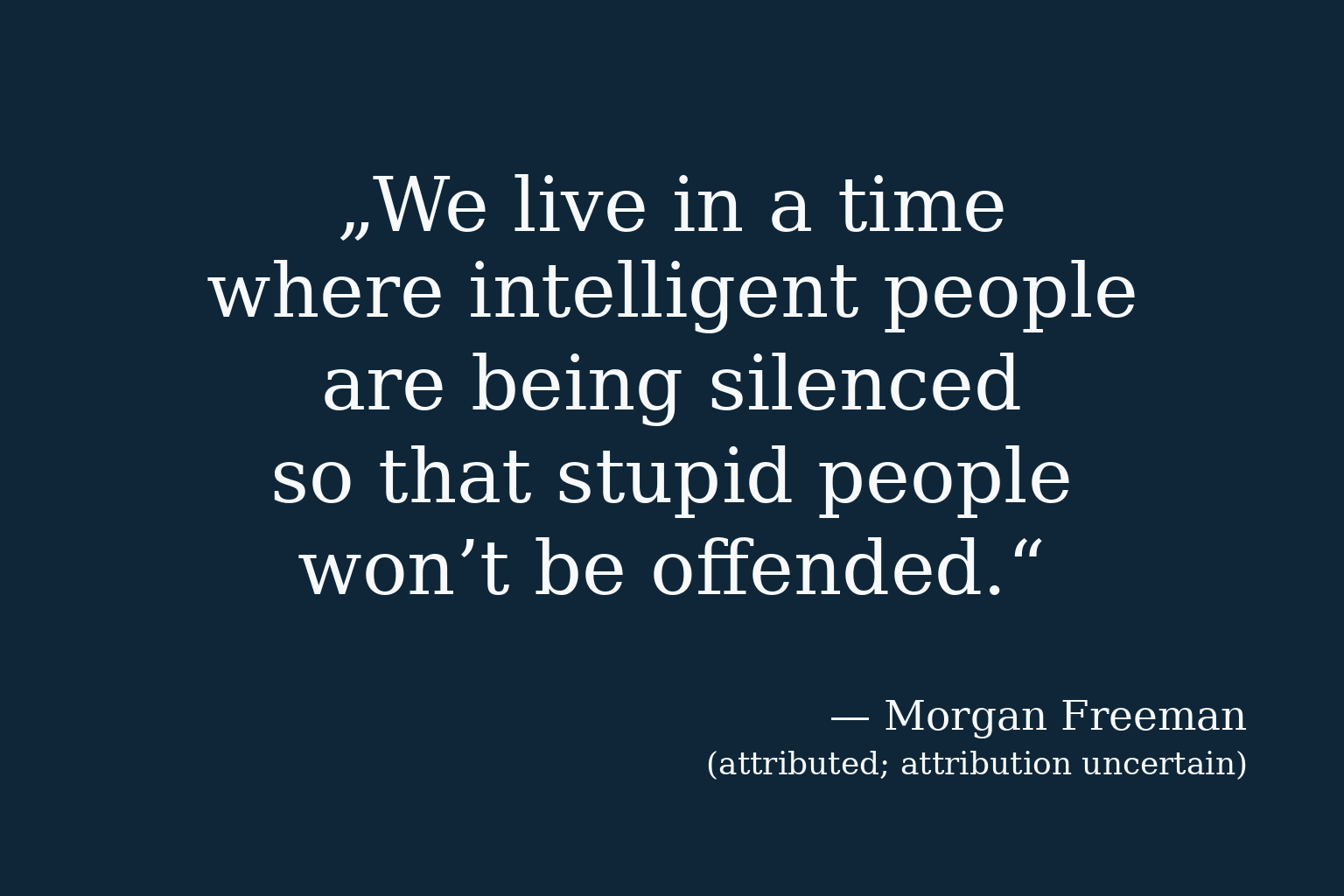
That was all there was. Just this one sentence, set in large, striking type — as so often happens on social media: as brief as possible, as unequivocal as possible, and perfectly suited to provoke immediate agreement or outrage.
Statements like this work best when we do not linger over them. At first sight they sound plausible, perhaps even profound. But that is precisely why they deserve a closer look.
As soon as we start asking questions, the sentence becomes much less clear.
Whether Morgan Freeman actually said it is not really important to me here. What interests me is the claim itself.
Who belongs to which group?
Am I one of the intelligent people — or one of the stupid ones? And who decides that?
If I consider myself intelligent, who exactly is silencing me? A government? A social-media platform? Other people? Or am I simply experiencing disagreement or criticism?
And what are the supposedly “stupid” people offended by? By the truth? Or by the way the “intelligent” people present that truth?
Do intelligent people sometimes make others feel stupid — intentionally or unintentionally — and then interpret the reaction as an inability to face the truth?
And is an intelligent person necessarily right? Intelligence does not protect anyone from prejudice, ideology, arrogance, motivated reasoning or simply being mistaken.
What does “silenced” mean?
Being forbidden by the state to speak is very different from being criticised, losing followers, being excluded from a particular discussion, or simply discovering that other people strongly disagree.
The same ambiguity applies to “offended”. Is someone offended because a fact is uncomfortable? Because an opinion challenges a worldview? Or because the statement itself is insulting or contemptuous?
Without clarifying these words, the quotation can mean almost anything. And precisely because it is vague, many readers can fit their own experiences into it.
A sentence designed to flatter us?
There is another question I find particularly interesting: why is the sentence constructed in such a way that almost everyone reading it will instinctively place themselves among the “intelligent people”?
Very few people will read it and think: “Yes, I am probably one of the stupid people they are talking about.”
Perhaps that is precisely what makes such statements so attractive. They divide the world into two groups: those who understand what is really going on — and the others. And somehow, we almost always find ourselves in the first group.
That should make us suspicious, especially when a statement confirms not only what we already believe, but also our favourable opinion of ourselves.
The question I find most useful
Instead of asking only whether the quotation is true, I think a more revealing question is:
What would convince me that it is false?
If the answer is “nothing”, then I am no longer testing a claim. I am protecting a belief.
And perhaps that is the real critical-thinking exercise hidden inside this Facebook quotation: not deciding whether we are among the intelligent or the stupid, but examining how quickly we accept a statement that invites us to place ourselves on the flattering side of the divide.